Wednesday, August 3, 2022

Life in a Human Town

Every town you find has a life of its own.  Sometimes it's about the small things that add flavor to the story, but sometimes the town brings its own new trouble to the game.  (And trouble usually means adventure.)

Humans are a community-oriented species that typically get most of their food from farming, supplemented by extensive hunting and gathering from the land around.  The average human tribe grows corn, hunts deer in the woods, and catches fish in the streams and lakes.

Let's roll up an example town as we go along.  This is Peace Junction, a town of the Istansi tribe, known for their copperworking and wooden plank houses.

When you arrive, everyday life is happening.  Roll twice (for the current season):

Goings-On (d20 twice)
Spring 1: plant corn, 2: build a new house, 3: harvest birch bark, 4: make a canoe, 5: town dance, 6: head to a bigger town for work, 7: prepare gardens, 8: pick ferns, 9: feed fish to dogs, 10: collect seaweed, 11: old folks reminisce, 12: clean muskets, 13: plant potatoes, 14: argue, 15: tend wounded dog’s paw, 16: fix nets, 17: news from a crier, 18: pick flowers, 19: chase away a snake, 20: air out bedding
Summer 1: wedding, 2: barn raising, 3: pick berries, 4: dig potatoes, 5: gather oysters, 6: huckster, 7: smoking fish, 8: fish at dawn/dusk, 9: gather eggs, 10: leaky canoe, 11: visit relatives, 12: sharpen knives, 13: hunt rabbits, 14: cook fish over a fire, 15: row and call loudly in unison, 16: kids skip stones on a pond, 17: wash clothes, 18: bathe, 19: haul water, 20: lounge in the heat
Fall 1: corn-husking bee, 2: pick pumpkins, 3: harvest festival, 4: hunt turkeys, 5: grind cornmeal, 6: afternoon fishing, 7: gather firewood, 8: hang up food in the rafters, 9: render fish oil, 10: hunt deer, 11: footrace, 12: archery practice, 13: examine a pig, 14: trim logs, 15: pick wild rice, 16: funeral rites, 17: skin a deer, 18: make corn beer, 19: boil acorns, 20: smoke fish
Winter 1: coppice trees, 2: maple sugaring, 3: fix palisade, 4: hunt deer, 5: tell an old story, 6: smoke meat, 7: hunt bears, 8: collect antlers, 9: fix snowshoes, 10: sharpen an axe, 11: deal with fallen tree, 12: knock icicles off, 13: break up fighting dogs, 14: kids throw snowballs, 15: hit someone with sticks, 16: ritual to ward off evil, 17: watch dogs chase a rabbit, 18: repair a collapsed roof, 19: keep warm around a fire, 20: sickness

You arrive at Peace Junction in the springtime.  Some children are picking flowers while a few adults are having an argument about a dog.

Town sites are carefully chosen for a mix of defensibility and easy access to food sources.  Towns tend to move every few years to avoid depleting the local resources.  If the town is ever attacked (or if you're trying to sneak in) you'll probably want to know what surrounds the settlement.

Surroundings (d8 thrice)
1 marshy area, tall reeds, mud, bog, sand dune
2 bluff, cliff, waterfall, boulders, scree
3 densely-overgrown thicket, tall-grass, thorns
4 cornfields, fishponds, gardens, livestock corral
5 pond, lake, wide place in the river, bayou
6 open meadow, clearing, pasture, fallow fields
7 shallow water, sandy beach, gravel bar
8 steeper slope, hillside, spire of rock, lookout

Peace Junction is built on the shores of a lake.  To one side the land is densely overgrown with thorny vines.  To the other, the humans tend extensive cornfields.

Somewhere nearby (a few miles off, up to about a day's walk) is something that affects life in this town.  It could be something they're aware of or that they're about to become aware of.  Roll twice and combine the results as best you can:

Nearby (d10 twice)
1 Bandits on a major Road to another settlement
2 encampment of Outlaws, banished from the tribe
3 gathering of a shunned Religious group
4 Fort built/captured by the tribe’s enemy
5 site of a Battle or a Massacre
6 contested Hunting grounds
7 Stolen property: boat, weapons, pigs
8 Crossroads where travelers spend the night
9 secret place where Medicinal herbs grow
10 burned former site of this Town, now abandoned

A few miles up the road is a group of bandits that prey on travelers between towns.  Recently they beat up a group traveling from Peace Junction and stole their muskets.

The people in this town aren't just sitting around waiting for life to happen to them, they've got goals.  Roll twice for their current goals.  These probably aren't tied together, so they might have to pursue one at the expense of the other, depending what's going on in their area.

Current Aims (d20 twice)
1 Assert a claim to land used by another town.
2 Regain leadership of the tribe.
3 Steal from a powerful enemy some ways off.
4 Seek vengeance for a murder.
5 Make money in the employ of a rich neighbor.
6 Gain access to powerful imperial trade goods.
7 Seize control of a trail, pass, waterway.
8 Root out witchcraft.
9 Drive out an enemy and take their land.
10 Move the town to a better food source.
11 Profit from a great Opportunity.
12 Avoid the danger of a great Opportunity.
13 Hunt a creature: large, fearsome, good food.
14 Make peace with a longstanding enemy.
15 Recover something stolen from the town.
16 Send someone far away to trade.
17 Build a large house, boat, fortification.
18 Investigate clues leading to a secret.
19 Find a cure for someone who is deathly ill.
20 Rescue their people who are taken captive.

The people of Peace Junction want to open trade with someone far away.  They're also trying to avoid the danger of one of the opportunities driving this campaign.  (Maybe someone is trying to establish a utopian colony on their land, or maybe there's a migration passing through this country.)
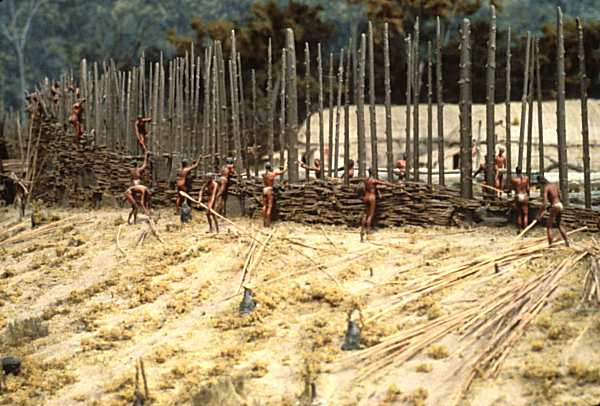
If you've never been to this town before, the authorities will have to figure out what to do with you.  This is not a land with tourists and sight-seers.  Roll once to see what the leaders decide:

Leaders Desire to (d8)
1 charge you a substantial Fee for traveling here.
2 see the valuable Gifts you have brought them.
3 have you Stay as a pawn for internal debates.
4 Trade with you for corn, blankets, guns, iron.
5 gain Information about military, opportunities.
6 Rob you for the valuables you must carry.
7 take you Captive as their people do.
8 send you to visit a Higher Authority.

Istansi towns are led by popular consensus.  When you arrive at Peace Junction, the people gather and question you about your own people: where you come from, what military strength your people have, how your guns work, and whether your people are likely to be a threat to the Istansi.
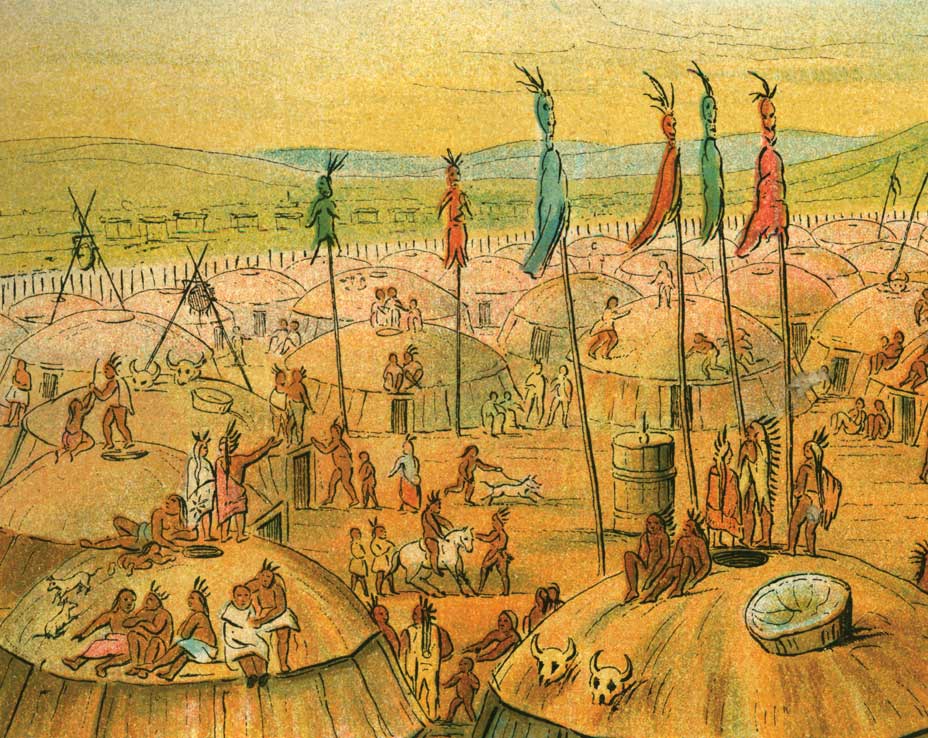
This town has something special that makes it stand out from others in the region.  Roll twice to see what they have:

They Have (d20 twice)
1 an Elder knowledgeable in History
2 Rumors of a near-by country, mostly true
3 an Affable or Pugnacious leader
4 secret Tunnels or a fortified Redoubt
5 stockpile of Weapons, hidden or for threats
6 speaker of another Language / unusual Captive
7 preparations for a Feast, warm Hospitality
8 Feud with a neighboring settlement
9 body of a strange Creature
10 fake Fire-Arms, skillfuly carved and painted
11 Blacksmith (if near colonials), Flint-knapper
12 hidden Caves w/art that tells an ancient tale
13 plan to Rob or Kill certain visitors
14 Wealth in gold, jade, furs, livestock
15 many Captives taken in battle
16 boats or livestock acquired from Neighbors
17 renowned Healer / trade in Medicines
18 Shrine or old Burial ground nearby
19 Visitor from afar, come to trade, explore, treat
20 folk-Magick known to only a few

Peace Junction is renowned for their elder who knows the ancient history of this land, but they also have a form of folk magic that has been mostly forgotten these days.


Roll up some random human town life for yourself:

Click here for random results.
spring
spring
summer
summer
fall
fall
winter
winter
surroundings
surroundings
surroundings
nearby
nearby
aims
aims
leaders desire to
town has
town has

Saturday, July 9, 2022

Defining a setting in Four Images

Adding detail is easy; taking it away is hard.  There's a value in distilling something down to its simplest elements, stripping away all else to reveal the bones underneath.  One of the hardest posts on this blog to write was the very first one, where I tried to summarize the entire concept of this setting.  Like it says above, this is:

A 1700s post-apocalyptic hopeful frontier fantasy setting for roleplaying games.

I saw a post from The Theoretical GM where he distilled his entire setting down into four images, and I thought that made for a great challenge.  So here's Signs in the Wilderness in just four images:

I'm not sure if these images convey all the concepts I was hoping for, but here's what I wanted to get across: the era of muskets, ambush and skirmish warfare, contact between different kinds of people, a big world full of wilderness to explore, canoes and travel by water, religion, ruin, and a North American setting.

If you've got a setting of your own, I'd love to see what four images you'd pick out.  Drop a comment below or send me a message on Reddit.

The Great Mountain

When rolling up a random country, sometimes you find a wonder of the world.  These are singular places, not found anywhere else.  There are many mountains in the Northern Lands, but only one is the Mountain.

Citlaltépetl

To the humans it is Asanamaqua "noble mountain" or Nontomaqua "thunder mountain".  The giants call it Yaxokuy "ancient mother" or Yotoyasa "smoke mountain".  To the tree-goblins it is Taocabáya "the one that reaches highest".

Shiprock

The great mountain can be seen on the horizon from afar (from at least 50 miles / 80 km away), looking like a cloud at first, far higher than any mountain should be.

(If you'd like to use the great Mountain in your own game, roll everything up first before introducing it, as some of the rolls may influence how you present the mountain earlier on.)

Chimborazo

As you approach the mountain, you find three things:

Approach (d10 thrice)
1Mountaintop is always wreathed in clouds.
2Black smoke, ash falls within 100 miles (160 km).
3Thriving society worships the mountain as a capricious god.
4Ancient lava tunnels with lost relics, strange bones.
5Lush & verdant landscape, strange plants found only here.
6Geysers & hot mineral springs, believed to heal.
7Locals forbid outsiders to set foot on the mountain.
8Pilgrims from an unknown land come to holy mountain.
9Symbol of the mountain on houses, boats, tattoos.
10Dying people come here to ascend into heaven.

Let's roll up our own version of the great Nontomaqua.

  • A thriving society lives in this land, worshiping the mountain as a capricious god.
  • There are geysers and hot springs nearby, said to have healing patterns.
  • Black smoke billows forth from the mountain, and ash sometimes falls on the land.

Climbing the mountain is an arduous task, requiring mountaineering expertise and equipment.  A climb is going to take several days at least, possibly much longer.  Use whatever mountaineering rules your system provides.

On your way up you find several things.  Roll on this table, but each time you roll, add +1 for each roll you've already done, then keep going until you hit End.  For example, your first roll is +0, then your next roll is +1, then a roll at +2, and so on until you get an entry that says End.

Ascent (d10 +1 for each roll so far)
1Offerings left for the god of the mountain.
2Outlaws/lepers banished to live in caves.
3An annual climb to offer sacrifices on the mountain.
4Caverns and tunnels, plants with very deep roots.
5Sheer cliffs, hard to find a safe climbing route.
6Perpetual fog, fearsome plant/animal life.
7Cyclopean Monument of a lost kingdom.
8A garden of Rest and Sustenance among the clouds.
9Scrawny & gnarled trees as you reach the treeline.
10Loose rocks, scree, prone to landslides/avalanches.
11Signs of hidden/lost people living within the mountain.
12Enormous birds, heart-eating condors, nests.
13Saddle where a lesser peak meets this mountain.
14Remnant of an ancient bridge/steps/road.
15Perilous overhangs, chimneys, high winds.
16The air is hard to breathe from here on up.
17Tiny flowers that bring healing and true sight.
18Something that fell from the Heavens (this table should be ready soon).
19Wise teacher of unexpected age/species. (End)
20Ancient & Terrible being beneath the ice. (End)
21+The mountain reaches into the lower tier of the Heavens. (End)

On our example Nontomaqua, here's what we find on the way up:

  • People on an annual climb to offer sacrifices on the mountain.
  • A place of perpetual fog, with dangerous animal/plant life.
  • Loose rocks and scree, prone to landslides.
  • Sheer cliffs, hard to find a safe climbing route.
  • A cyclopean monument of a lost civilization.
  • The air is thin and hard to breathe from here on up.
  • A saddle where a lesser peak meets this mountain.
  • A place of perilous overhangs, chimneys, and high winds.
  • At the peak: a wise teacher of an unexpected age and/or species.

But before we figure out what all this means, we need to understand the secret of the mountain.  Roll twice and combine them, even if the results feel strange together.  Maybe one caused the other, or one is the guardian of the other, or one is the true form of the other.

Secret (d6)
1A mighty god of storms and ice inhabits the mountain, misunderstood by the people below.
2This volcano is soon to erupt, threatening all. Religions tell of a time when the world was once destroyed in fire, many ages ago.
3It is a petrified remnant, the stump of an ancient tree of inconceivable size. A seed of this tree remains, hidden on or beneath the earth.
4Spirits of the ancient dead dwell on the mountaintop and bid you join them, whispering in dreams.
5When a planetary conjunction occurs above, the peak draws near the heavens and the very stars.
6Its heart is a fallen tool of a colossal being of myth who shaped the young land long ago: the bag where they kept soil, the axe they used to carve canyons, a ball from a great game of the gods.

For our example mountain, the secret involves:

  • At the moment of a rare planetary conjunction above, the mountaintop draws near to the heavens and the very stars.
  • This volcano is soon to erupt, threatening everyone.

Both of these are events that happen at a moment in time, so let's say they happen at the same time.  At the moment of a rare planetary conjunction directly overhead, the mountain will erupt and cause a time of great darkness, but some strange and transcendant event will occur, connecting the peak to the heavens above.

I think this would make a great end to a campaign: astronomers predicting a rare conjunction, a prophet proclaiming that the planetary alignment will end the world, divine forces of heavenly beings at work, and everything comes to a head atop the tallest mountain in the world.

Taniquetil

I'm deliberately leaving the strangest things of the mountain a little bit underspecified.  In a roleplaying game, I think it's the small things that need the most contrained guidance from the rules: how much you can carry, what happens when you try to stab someone, how often you need food.  The larger you go, the more open the guidance needs to be, until the rules are just a spark for your own imagination.  At least that's what works for me.

No random roller today (my code doesn't support an escalating sequence yet), so you'll have to grab some dice and try it for yourself.

Saturday, June 25, 2022

Random Map: Inhabitants

Randomly-generated countries need people to live in them!  Last time we looked at rolling up a country, terrain was the focus.  Today, let's see who lives there.

First I'll roll up some random terrain from that table as we go through an example country:

  • Ridges run northeast-southwest that can easily be walked along.
  • Deep ravines run between the ridges with cascading streams.
  • The sea is to the east, a rocky coast with waterfalls and few safe landings.

There are four species of people in Signs in the Wilderness: the Colonial city-people who tend to live by the sea, the roaming Giants who can eke out a living in more marginal terrain, the Humans who farm and hunt best in lightly wooded valleys with lakes, and the tree-dwelling Goblins who prefer swamps and thick forests.

Roll three times to see which peoples have the most effect on this country:

Locals (d20)
1-3colonials
4-9giants
10-13goblins
14-20humans

For our example country I got giants, humans, and humans.  If you get the same result twice, that's fine.

Terrain makes a difference to these people: goblins thrive in swamps but don't do much with island chains, for example.  For each people result you got, check to see what their modifier is in this land:

Modifier+1 for each of-1 for each of
colonialswarm coast, harbor, rivers near the seafar north, inland, no easy way to sea
giantshighlands, ponds, open countrythick woods, swamps, far south
goblinsdense forests, swamps, cliffsopen country, islands, deserts
humanslakes, wide valleys, semi-woodedrugged mts., swamps, deserts

Looking at the modifiers for giants, I have to make some decisions about what this country is like.  I think I'd like it to be densely forested (a -1 for giants) but I'd also like the ridges to be easily walkable because they're thinly forested up near the treeline (which seems like highlands, a +1 for giants).  Net, that's a +0 for giants.

For the humans in this land, they get a -1 due to the ruggedness of the ridges and ravines, and I don't think any of their other modifiers apply.

From this point on, each of the four peoples has their own table.  If one of your results was Humans, roll on the Humans table plus their modifier, and so on for whichever other peoples you got.

Humans (2d6 + modifier)
≤2humans once lived here, Tales of nomads skilled in folk magick, natural phenomena ascribed to human powers
3few scattered towns warring over resources, Meager Remnant of a once-great tribe
4-5a struggling Tribe among many Ruins
6rival Towns on brink of war, forbidden zone
7ancient ruin, strife with newly-arrived Tribe
8thinly-settled Hunting grounds newly taken by a strong tribe, many burned towns
9Tribe of neighboring country recently invaded
10-11Trade center, many other towns, roads
12Forbidden kingdom, outsiders put to death, trade via trusted intermediaries
13+Nation whose Power extends to other lands, collecting tribute and tolls, raiding to seize captives and suppress enemies

Because we got humans twice up above, I'm rolling twice here on the Humans table, both times applying their -1 modifier due to the terrain.

  • The first result is 5: a struggling Tribe among many Ruins.  Those ruins might be from other people about to be rolled up, or they might be from other people that used to live here.  Maybe they're from an older civilization that once inhabited this land.
  • Next, an 8: thinly-settled Hunting grounds newly taken by a strong tribe, many burned towns.  There's conflict in this land already.  Not sure if the burned towns belong to the struggling tribe or if they're someone else's, maybe a tribe that was entirely driven out?
Colonials (2d6 + modifier)
≤1stories of an Expedition that came through, artifacts, possibly survivors
2-4imperial Guns & trade goods, no colonials
5forgotten town of religious exiles, ruins of a fort/mine
6trading post of a Company
7Fort, abandoned settlements
8two of: trading post, fort, mission
9-10largely controlled by a far-off Company: resource settlements, trading posts, old fort
11-12several settlements among many ruins
13+one of the chief surviving Colonies and its outlying settlements/forts/&c.

Today's example country doesn't have any significant colonial presence, but as you can see from the table, colonial influence can range anywhere from mere stories of an earlier explorer to a major colonial city.

Giants (2d6 + modifier)
≤2giants are gone, landforms said to be built by them, Tales of wanderers
3a Mission abandoned by the colonials, now run by the descendants of its students
4-5scattered trappers, fishers, herders, traders
6many wandering Traders
7perilous ruins of a dead House
8two Rival houses, contested border
9three houses: Weak, Strong, and Ruined
10-11a Mighty ruling house, several smaller ones
12+a powerful Alliance of three great houses

The giants in this country have two rival houses with a contested border between them.  I think that's enough groups here to cause plenty of interesting conflict with shifting alliances: two rival Houses, a strong Tribe, and a struggling Tribe whose towns were burned down.

Goblins (2d6 + modifier)
≤1goblins once lived here, forbidden woods, Tales that confuse them with ghosts
2-5one powerful village in a Secluded region
6-8three main Villages compete for hunting grounds, prey on livestock of others
9-12Populous, good hunting grounds, outsiders fear this land, a few giantish traders
13+interspersed villages of three major Clans, people travel from far away to study, trade, visit renowned hermits

Each of these tables has a result for mere stories and legends, for a country that doesn't really know who those people are, but remembers bits and pieces.  Tales of goblins from long ago tend to confuse them with ghosts or other strange beings that come from forbidden woods in the night and prey on settlements.

Legends of humans tend to see them as some kind of magicians who control things like the weather.  A country that hasn't seen humans since long before the apocalypse might ascribe a cold north wind to hidden humans up in the passes.

Distorted memories of giants lead to stories of them shaping the land, saying this hill was raised by the giants, or this canyon was carved by them.

Go here to roll up some terrain, then roll to see who lives there.  (The random roller here doesn't properly take the modifiers into account.)

Click here for random inhabitants.
1
2
3

Giants and their House-Corporations

Giants always come back to their House.  As trappers and herders, giants spend most of the year on their own, only seeing others every once in a while.  But each spring, they come back to their ancestral home.

The House is like a corporation, thought of as a person that can own property.  It is a physical structure, but also a kin-group and a territory.  The house is a symbol of the lineage that gathers there and is governed by its highest-ranking members.  (Most of the time, only those of the first rank live at the house, sustained by tribute from lower-ranking giants.) 

Each House has a sigil, marked at the house and at the boundaries of its land.  The name of the house describes the appearance of its sign using specialized terminology, names like Lazy Deer, Diamond Walking Snake, or Smoke Over Turkey.

Membership comes with rights to gain food from the land on your appointed circuit.  Roll twice to see what kind of harvest rights are available:

Harvest Rights (d10)
1-3 Gathering, diving, beach-combing (d10) 1: clams/mussels, 2: walnuts, 3: acorns, 4: snails, 5: mushrooms, 6: eggs, 7: persimmons/huckleberries, 8: crab apples, 9: carrots/dandelions, 10: seals/walruses
4-5 Trapping, snares, bait, pit traps with stakes (d10) 1-2: jackrabbits, 3: geese, 4: otters, 5: beaver, 6: ducks, 7: squirrels, 8: turkeys, 9: raccoons, 10: goblins
6-7 Fishing with stone weirs, basket traps, spears (d10) 1-2: trout, 3-4: salmon, 5-6: crawdads, 7: bass, 8: eel, 9: herring, 10: river shrimp
8-9 Grazing herd animals for meat, cheese, wool (d10) 1-2: llamas, 3-4: alpacas, 5-6: bactrian camels, 7-8: yaks, 9-10: colonial longhorn cattle
10 Driving stampedes off cliffs, through narrow defiles (d10) 1-3: buffalo, 4-6: caribou, 7-8: bighorn sheep, 9-10: strange herd animals

taking the herd to good pastures

Wander about in search of food, but do not wander too far.  Each house governs a territory 20 to 100 miles across (30-160 km), enough room for hundreds to find food.

Border (d20)
1-3 Sea, large river, lake
4-6 Waterfall, rapids, cliff
7-9 Swamp, salt marsh
10-12 Ridgeline, desert
13-14 edge of the Forest
15-16 low range of Hills
17-19 Rock, standing stone
20 remnant of a lost Civilization

For each border, roll to see what the relations with the neighbors across that border are like.

Neighbors (d20)
1-3 long friendship
4-6 wary truce
7-9 enemies
10-12 paying tribute
13-14 peaceful trade
15-16 died/emigrated
17-20 shaky alliance against new enemy

stalking buffalo while wearing animal disguises

Near the house are a few places important to the people here:

Nearby Site (d6)
1 ancient Tree, alone on a grassy hill
2 deep Sinkhole with water, a cenote
3 natural Pillar of stone, a kigilyakh
4 large Cavern, difficult to reach
5 long-abandoned House
6 Ruin of an old kingdom

Roll to see the significance of each site.

Importance (d6)
1 Shamanist rituals take place there
2 forgotten Treasure hidden there
3 great Battle was fought there long ago
4 place of meeting Enemies under truce
5 Healing is said to happen there
6 new Religious movement gathers

The house itself is in a defensive position, used as a refuge in times of war.

Site (d6)
1-2 high on a Pinnacle, steep steps cut in rock
3-4 raised earthen Mound, riddled with ancient passageways
5-6 steep-sided Hill, only one shallow approach

But the house is also meant to be a gathering place for its hundreds of people.

(d6) Around Structure
1 stone wall 5 feet high (1.5 m) stone/adobe walls with no gates, only ladders
2 steep-banked stream raised high up on massive wooden pillars
3 hidden triplines and pit traps circular stone wall, open-air courtyard
4 many large wooden spikes roofed pavilion, open on all sides
5 hilltop sentries, signal fires fenced-in garden with fruit trees
6 wide circle of standing stones mission once built by the Colonials

The house itself has a few features to make life easier for the indolent first-rank members, or to support the annual gathering.

At the House (d8)
1 Lodge for the reclusive first-ranking members
2 open space for Games or the Moonlit Play
3 Cellar for storage of food, ice, or valuables
4 Granary or Treasure House up on stilts
5 cistern/cenote full of Drinking Water
6 lookout Tower, occupied at all times
7 Workshop for carving, flintknapping, weaving
8 Racks for stretching hides, drying fish/tobacco

a time for serious debate

Whether they're at the house or out on their rounds, the people of this House have been debating serious matters for the year ahead.

Topics of Debate (d12)
1 Fear that the War shall be reignited.
2 Whether the Prophecy be true.
3 Violent dispute with neighboring people.
4 Strange Travelers in these lands.
5 New religion in the lower ranks of the house.
6 Too many people; must establish a new House.
7 A great Deed to restore their dwindling glory.
8 Access to colonial arms, food, trade.
9 Vengeance for an ancient Crime against them.
10 Role in a greater Alliance of houses.
11 Risk of pursuing a great Opportunity.
12 A leader who cannot be trusted.

Let's roll up a random House, Dead Broken Fence:

  • People here gather persimmons and drive bighorn sheep into narrow places where they can be hunted.
  • Long friendship with those who live beyond the marsh.
  • Shaky alliance with those who live over the hills, allied against a new enemy.
  • A new religious movement among the people gathers in secret at a nearby abandoned House.
  • Meetings under truce are conducted at the standing stone.
  • Sentries keep watch from hilltops near the house.
  • The house itself is raised on mighty wooden pillars atop a steep-sided hill.
  • At the house there is a separate lodge for the first rank, a cistern for collecting rainwater, and a place for stretching and drying hides.
  • People debate whether the House has grown too large and shall have to split off a new House.

Roll up your own giantish House:

Click here for a random House.
food to harvest


border relations


nearby sites


site of the house
around the house
structure of the house
features at the house


matter for debate

Sunday, March 20, 2022

Real-time Coastal Hatching

You've probably seen old maps with little lines along the coast, right?  Back in the days of ink and engravings those were tedious to draw.  I've tried a lot of different methods to add this kind of hatching to maps in Photoshop, but they've all been slow.

What I'm going to show you here is applied in real time.  Once you've set up your layer style, you can just draw and the hatching is applied automatically.

These instructions are for Photoshop, so if you're using a different drawing program, let me know what you do differently.

Mask a fill layer

Start off with a simple fill layer.  This is a layer that's already full of a single color, with a mask that lets you show or hide it as you like.  (Go to the menu: Layer > New Fill Layer > Solid Color.)

Draw the shape of the land in the mask to reveal the color.  (By default the mask will show color everywhere, which is the opposite of what you want.  There are many ways to switch the mask to hide everything: one is to select the mask and hit Ctrl-I to invert it.)

Noisy inner shadow

Open up the layer style.  (Right-click on the name of the layer and go to Blending Options, or just double-click on the layer.)

Add an inner shadow to show the edge of the coastline.  The default settings make a soft-edged shadow, which isn't what we want here.  Turn the Choke most of the way up (so the shadow is mostly opaque) and set the Size to just a few pixels.  Add a little bit of Noise (I'm using 10% for this demo).


Notice how the white area is hidden here?  Put the layer in a folder, then set that folder's blending mode to Multiply.  That means anything in white will be transparent this will be important later.

Stroke hatching

Next we're going to add the little lines that stick out into the water.  You'll need to draw a hatching pattern to do this, or you can use mine if you like.  (Non-commercial purposes only.)

If you draw one yourself, make sure the left and right edges match (and the top and bottom edges) so that it can tile seamlessly.  (I could do a tutorial on making seamless textures if you guys want.)

Open up your hatching tile as a separate image, make it into a pattern, then head back to the map.  (Edit > Define Pattern.)

In the layer style, add a Stroke.  For the Fill Type, choose Pattern, and select the hatching pattern you just defined.  Set the Blend Mode to Difference.  This will draw a band of that pattern around the edge of the coastline.

Click the Overprint check box for this stroke, so the hatching will be drawn on top of the other effects we'll add soon.

This is ok, but it's not great.  Ideally we'd like the hatching to be bolder near the land and less intense further out in the water.  To do that, we'll need a few more copies of the pattern.

Add another Stroke just like the previous one, but increase the size.

Then add a third Stroke the same way.  (You might need to tinker with the size and opacity a bit to get an effect you like.)

Reversed outer glow to hide hatching

We're getting closer, but the outer edge is still too regular.  We need something further out from the coast that's fuzzy and noisy to cover up the edges of the hatching.

An outer glow or a drop shadow would be perfect, but those usually are stronger near the object, fading off further away.  Thankfully, we can invert the direction.

(Outer Glow and Drop Shadow both have a similar effect here.  I ended up using both on my own image for finer control, but you can go it with just one.)

Add an Outer Glow, then reverse the contour.

If you don't already have a reversed contour in that little menu, just click on the contour itself and drag the handles to reverse it, like in this image.

When we're done the outer glow will need to be white, but for now, make it red.

Adjust the size and spread until the outer glow is strongest out at the far edge of the hatching, fading off as the glow approaches the land.  Add some noise for roughness, then it should look something like this:

Notice how that red band is covering up the outer part of the hatching?  That's exactly what we want, if only the red band were invisible.

Change its color from red to white, and it'll disappear.  (It disappears because this layer is inside a folder set to Multiply.  Using the Multiply blending mode, white manifests as transparency.)

That's it for the coastline.  Draw the rest of the owl and you get something like this:

Summary

  1. Make a hatching pattern from a separate image.
  2. Draw the land shape using a fill layer.
  3. Put the fill layer in a folder that has Blend (Multiply).
  4. Add a layer style: Inner Shadow: high Choke, some Noise.
  5. Add a Stroke: Fill (Pattern), Blend (Difference), Overprint.
  6. Add two more of that Stroke, each one with a larger Size.
  7. Add a red Outer Glow: Contour (reversed), some Noise, moderate Spread, enough Size so it's out at the edge of the hatching.
  8. Change the Outer Glow to white.

Once you've made your layer style, you can save it or just copy it from one map to another.  You only have to do those steps once; from then on, all your coastal hatching can be done in real time.

Are there any steps you'd like to see in more detail?  Let me know, either here or on the subreddit, and I'll add them in.

Thursday, July 1, 2021

Rolling up Today's Campaign

Want to see how a campaign is made?  Or just want to join us for some adventure?

I'm starting up a new play-by-post game over on Discord.

The first step is choosing an Opportunity, a premise for the initial adventure.  I'm suggesting we start with one of these:

  1. Establishing a new community in the wilderness.
  2. Avoiding the law to survive as smugglers.
  3. Searching for a lost treasure.
  4. Protecting a remote outpost on the frontier.
  5. Leading the conquest of a poorly-understood country.
  6. Following a falling star to where it lands.

Once the players have chosen an opportunity to start with, we'll answer a few questions about the party, then we'll jump right into the adventure.


Meanwhile, I'll be posting on the behind-the-scenes channel about how the world is actually being made, as I roll everything up on random tables.  Last time we tried this it was a lot of fun, and as the GM, I enjoyed being surprised by the nature of the world unfolding around us as we adventured.

The game is going to focus on the fiction of the world, leaving aside any number-crunching and die-rolling mechanics for now.  (I'm interested in those, but that's not the focus of this playthrough.)

Feel free to drop in and out, or just watch if you like.  We're leaving the size of the party somewhat vague, so players can come and go as needed.