Showing posts with label supernatural. Show all posts

Saturday, November 23, 2024

Oracles; or, letting a Surprising Future derail your Story and Confound the Players

At last the ragged wanderers found themselves at the sacred grove.  There they sought an audience with the Oracle of the Broken Stone, to ask the one question no one could answer...

Oracles are a great way to add mystery and wonder to your game, for several reasons:

  • You find out what the players really care about discovering.  Give them just one chance to ask a question of a powerful oracle, and they'll use it for whatever mystery they care about most.
  • You get to say yes to the players.  So much of the GM's job is about placing obstacles in their way: enemies to fight, goals that are out of reach.  When the oracle speaks, they're giving the players something they actually want: knowledge and the promise of adventure.
  • You get to look like you planned everything, without having to plan everything.  The oracle tells the future in a cryptic way, then when you make it happen it looks like that was your plan all along!


Finding the Oracle

Never let the party stumble across an oracle by accident.  Before they ever meet the oracle, they've heard tales of their wisdom, how someone paid a great price to gain an audience, how a mighty king spent seven years choosing the right question to ask the oracle across the sea.

When they finally reach the oracle, make them ceremonially separated from ordinary life:

  • The oracle stays in darkness.
  • Their face is always covered.
  • Do not address the oracle directly.
  • You must bathe first and dress in simple clothes.
  • They're at the top of an enormous tree.
  • No metal can be in their presence, nor the color red.
  • You must kneel before them, never looking in their direction.
  • Heavy incense fills the air.
  • First you must eat meat roasted on a sacred fire and drink a bitter drink.
  • The oracle will touch your face and pour water on your head.


The Question

The oracle will now hear their question.  This is not a time for sneakiness on your part, like they're making a wish -- the oracle isn't a genie trying to twist the meaning.  After all, the party has suffered long travels and paid a price to be here, this is their chance to ask a meaningful question.

Whatever you do, don't suggest a question.  Let the players ask whatever they want, even if it derails your plot.

You could even let them ask more than one question, but there's a limit:

  • You may ask three questions, but only one of you may speak to present them.
  • You may each ask a question, but the oracle will not say which answer goes with which question.
  • You may ask one question now, and another after a year has gone by.

Do not give the answer in this game session.

Maybe the oracle says to come back when the moon is full, or that they have to go get the skull of a panther as payment.  Maybe you just tell the players that you need time to think.  They've asked a question, now you need time to give a good answer.


The Answer

To craft a good response, start with a straightforward answer:

  • Where's the lost gold?  At the bottom of the old mine you heard about in Salvinia.
  • How can we rescue our grandmother?  Go to the fortress of Standing Cloud and offer a thousand shillings for a ransom.
  • Who's behind the plot against the Northern Silver Company?  The Lord Mayor.

Next, add a twist.  I recommend picking just one:

  • The answer is straightforward, but something else will happen.
    • Finding the gold will start a war.
    • Your grandmother is already dying of an ailment she kept hidden.
    • The Lord Mayor isn't just trying to bring down Northern Silver, he's trying to bring down the whole economy of the region.
  • The answer isn't exactly so straightforward.  It's divided, twisted, tainted, misleading.
    • The gold is in the mine, but what you think is a mine isn't actually a mine.  It's a tomb of an ancient king, deep in the earth.
    • The woman you call "grandmother" isn't actually your grandmother.
    • The Lord Mayor is behind the attack on Northern Silver's ship, but he's being blackmailed to do it by a third party.
  • The question itself is wrong.  Give something else instead.
    • There is no lost gold.  The shipment was actually carrying a weather control machine, developed in secret before the Starving Time.
    • Your grandmother isn't in any danger, she's just on a long voyage away from home.  The ransom note was a distraction to get you to leave home.
    • Northern Silver didn't actually lose any ships, they paid the "pirates" to fake an attack.
  • Take your straightforward answer and come up with a second one, then combine them.  If the result doesn't make sense, do not explain it.
    • The gold is in a mine.  The gold is in a shipwreck.
    • Pay a ransom to Standing Cloud.  Set fire to the House of Eyes.
    • The Lord Mayor is behind the attacks.  The pirate king of the Hurricane Isles is to blame.

If the answer doesn't seem useful enough, add a piece of information that sounds valuable, even if you're not sure what it means yet.  The party went through all this trouble to get here, they deserve an answer that will help, when the time is right:

  • The gold cannot be retrieved without a way to breathe underwater.
  • There is a traitor in the house of Standing Cloud; the one with the stolen eye cannot be trusted.
  • The Northern Silver Company has three keys that fit three locks that must never be opened.


The Voice of the Oracle

You've got an answer, now let's make it sound like it came from an oracle.

Start by speaking about the power: mention that this is from an oracle, invoke ancient wisdom, describe the vision process, tell how this answer came to be.

  • Whispered come words from those in the deep...
  • For seven days and seven nights I slept and dreamed the sacred dream...
  • Hear now the hallowed word handed down from the spirits of old...

Add repetition and parallelism.  Don't just say it one way, say it twice in related ways.

  • Gold is in the earth, wealth deep in the ground.
  • Fortune comes to those in her path, good omens follow her footsteps.
  • A close friend will betray your company, an ally seeks to turn against you.

If you're not sure how to make it longer, try using shorter, disjointed pieces.

  • Deep and dark, glinting gold, old beams above, water below.
  • Wings, you bring feathers and wax, a fall from a height, death on the waves.
  • I see a tower and a bright beacon, three gray horses, a fire in the hearth at an old inn.

Don't just name it, describe it in a way the players would recognize.

  • If they know the Lord Mayor well, don't just say "the Lord Mayor", say "a blue hat on a tall hill, ink-stained hands from signing laws".  This gives the players room to all say "Yeah, that's gotta be the Lord Mayor; we've seen his blue hat and been to his house on the hill."

Use poetic forms where you can: alliteration, rhyme, meter.

  • "Soon sails a foul ship across a foggy sea" is much more oracular than "The enemy ship will head out soon on a foggy day".

Delivering the Answer

In your next game session, have the oracle deliver their answer.  Read the answer you wrote down, and give a copy to the players to pore over later.  (Or even have the players read the answer out loud for you.)

Then it's time to send them away and back to their ordinary adventuring life.  Talk about how the oracle covers their face again, how the party gets ready to change back into their regular clothes, how they now have to climb back down the tree, etc.  But before they go, there's one more thing...

Give the players one last detail that you don't understand.

  • She gives each of you a small bundle wrapped in yellow cloth, saying not to open it until the full moon.  (Don't decide what's in the bundle until they open it.  When they do, don't worry about coming up with a reason why she gave them a rabbit's foot or a clay figurine or a single bullet.)
  • The monk says you will not meet again until the rising of the red star.  (Don't worry about what that means.)
  • He says to return with the sword from across the sea, once you find it.  (What sword is this?  Figure it out later, or maybe never at all.)


Making the Answer True

Now it's your job to make the answer come true, even if it changes your ideas for a story.

If you don't know what the answer means or how to make it happen, give it some time, then ask the players how much of the oracle's answer they've figured out.  Maybe you don't know what "the gold is in the mine; the gold is in a shipwreck" means, but the players probably have some guesses.  Steal their ideas and twist them a little for the story -- they'll feel clever for figuring it out, and you'll look like you planned it in advance.

If the players completely derail the oracle's prediction, make it come true a different way.  Maybe you said the king would do something, then the party killed the king -- a new king will be crowned.  Maybe you said the Flying Star, a famous boat, would sail again, but the party burned it before it could go to sea -- the boat appears one night with a ghostly crew, or have an actual "flying star" show up, or have someone who can remake the boat from the ashes.  Oracles are about fate that cannot be averted; let their words break the rules.

tl;dr

  1. Ritual rules for meeting the oracle.
  2. Question in one game session; answer in the next.
  3. Start with a straightforward answer, give it a twist, add a useful detail.
  4. Make the answer poetic.
  5. After giving the answer, give a random detail that you don't understand yet.
  6. Make the answer come true, no matter what.

Friday, October 4, 2019

Magic Tool of Folklore

Many cultures tell stories about someone who carries a magic tool.  It could be a whistle that summons birds, a shoe that turns into a boat, a lasso that can catch stars...

a fishhook that can pull land up from the bottom of the sea


Stories like these are common in the Northern Lands, especially among the indigenous goblins, giants, and humans.  Like most folklore, these stories are full of myth and legend, but there's a chance that they contain a kernel of truth.

You might find one of these magic tools in your travels, and it might even have real magic.

Tool (d20)
1harpoon
2fishhook
3carving knife
4big straw hat
5leather boots
6woolen blanket
7gloves, mittens
8canoe, kayak
9musket
10snowshoes
11key
12sewing needle
13wooden mallet
14bow, arrow, arrowhead
15lasso
16ladder
17flute, whistle
18silver mirror
19copper kettle
20spoon

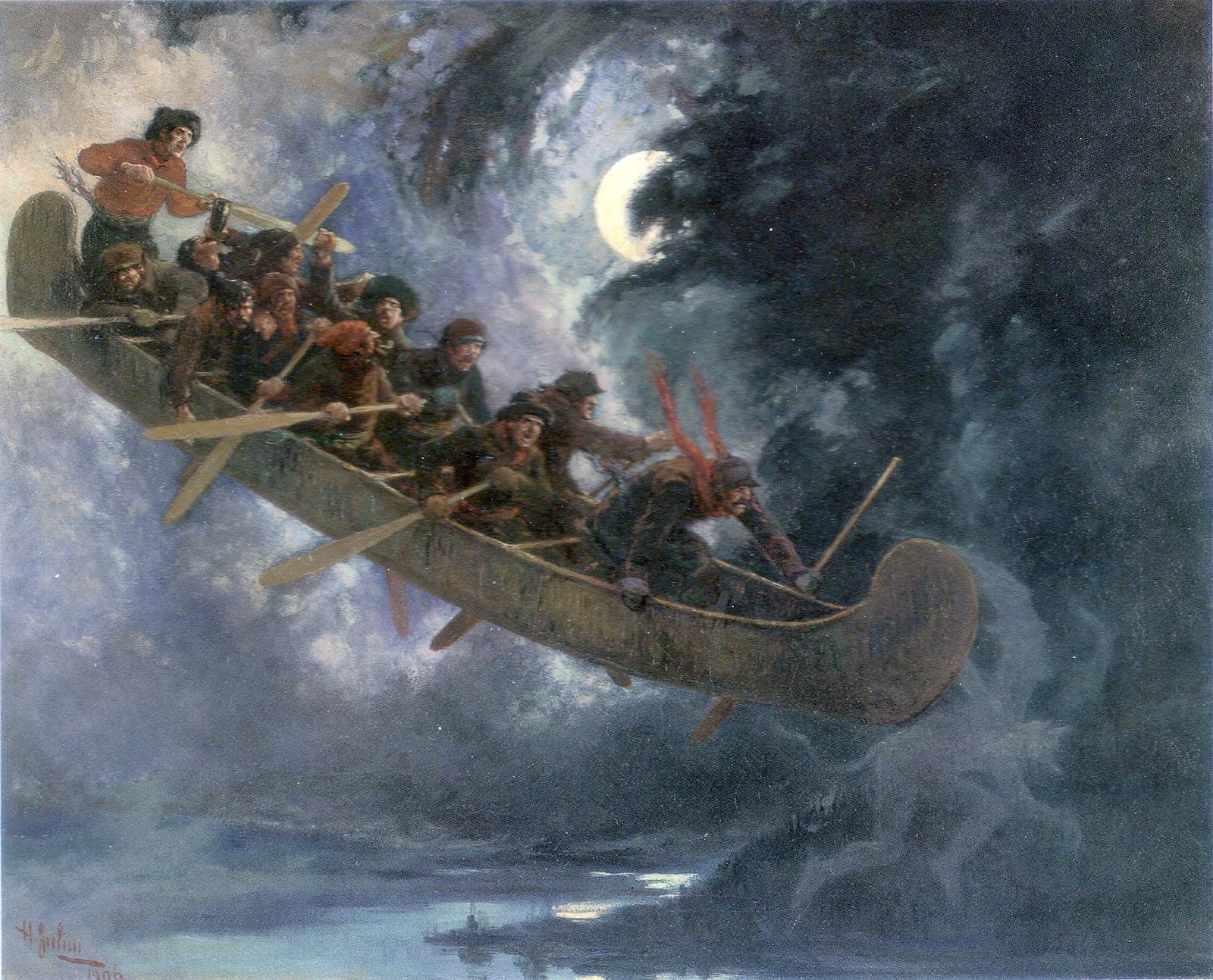
a canoe that glides through the air


Whatever this magic item is, it's fundamentally a tool with an ordinary purpose.  In the stories, it's used in some special way:

  • Some tools are just very, very good at what they do: a key that opens any lock, an arrow that always strikes its target, a cooking pot that makes all food delicious.
  • Some tools are used in the usual way, but with a different target than you'd expect, or operating in a different medium: a canoe that glides through the air, a ladder to climb to the night sky, a drum that can only be heard by the dead.
  • Some tools are used in a very unexpected way, or used like something with a vaguely similar form: a spoon that digs better than a shovel, a tentpole that shoots like a musket, a mitten that unfolds to be used as a tent.

Supposed Function (d10)
1-4Used for the usual purpose, but works unreasonably well.
5-8Used in the usual way, but with an unexpected target or medium.
9-10Used in an unexpected way, or as something with a vaguely similar form.

an axe that chops down the largest of trees


In the stories, it was always wielded by the same person.  The item belongs to them, at least in the popular imagination.

Wielded By (d6)
1-2a clever craftsman who made it (d4) 1: a while back, 2: far away, 3: for a wealthy patron, 4: for the gods
3-4a rising figure out on the frontier (d4) 1: a warlord, 2: a prophet, 3: a bringer of justice, 4: a renegade
5-6a culture hero who might have been real (d4) 1: a trickster, 2: a wise grandmotherly figure, 3: a kid who always finds a way out of trouble, 4: a thief/pirate

a rope that can lasso the sun


The stories tell what this object looks like.  If it's a knife, it's not just a regular knife; it glows in the moonlight or it has blood on it that won't wash off.

Appearance (d8)
1writing/picture/symbol carved into it
2has blood on it that won't wash off
3much larger than it has any right to be
4wrapped/covered in crow feathers, salmon skin, buffalo hide
5shiny, brightly colored, glows at night
6got some kind of eyes, hands, or feet
7makes a ringing or singing sound
8in an ancient style, worn smooth

a harpoon that catches the skin off a creature while it swims off to grow a new one


Legends and powers aside, if you find this tool, you might not want it.  Rare and famous things bring all kinds of problems, but if you need some ideas for what trouble this brings, roll a die.

Problem (d8)
1stolen from someone very powerful
2broken, fragile, bent, missing a piece
3people expect its holder to fulfill the original role from folklore
4troubled people need its help
5believers say it is a sign of the prophecy
6thieves/pirates on the lookout for it
7said to work too well: axe that keeps cutting down trees, shoes that make you walk too far
8said to stop working at inopportune moments


Roll up your own magic tool of folklore:

random magic tool
tool
function
wielded by
appearance
problem

Saturday, June 29, 2019

Magical deniability

Magic should be hidden.  It should lurk around the door, beyond the trees, in that little mahogany box under the floorboards.  Magic should be so secret that you're not quite sure it's really there...

...and then the door is thrown open, the stars rain down, and for a moment, the world is a truly magical place.


It's a hard feeling to capture.  Magicalness, almost by definition, can't be understood.  If you look at it too closely, it isn't magical anymore.  To paraphrase Arthur C. Clarke, "any sufficiently analyzed magic is indistinguishable from technology".

I've got a recipe for making magical moments.  It doesn't always work, and it probably won't work if you use it too much, but I thought I'd share it with you anyhow:
  1. Hide your magic in a mundane world.
  2. Show its effects, but explain them away.
  3. Reveal the magic.
  4. Take the magic away.
 

Sand in your shoes

First, you need a relatable, mundane world.  Magic is only special by comparison.  If you want to build to an amazing magical moment, you need to start with a mundane baseline.  This isn't a story about wizards flying around on dragons in space, this is a story about a guy who goes to the store and scrounges for change to buy some candy for his kid.

The details of your world don't have to be the same as ours, but they have to be relatable.  The players/readers/audience need to be able to imagine having their own everyday struggles in your world.  I'm not a fisherman or a turkey farmer, but I've had roughed-up hands from a hard day's work, and I know what a coop full of chickens smells like.

The more you focus on everyday struggles, the more wonderful magic will seem by comparison.  If your adventurers have struggled with mud and grime, and gotten scraped up sliding down a gravelly slope, and are tired and hungry, they'll be well-grounded in relatable details.

(This is part of why I'm so interested in outdoor survival in Signs in the Wilderness, and how it taps into your own experience in a visceral way.)

Deny everything

Next, you need plausible deniability.  If you reveal the magic too early, it won't feel magical; it'll jut feel like a dumb twist.  Imagine watching the first few minutes of a cop show, then having a wizard pop up out of nowhere.  It might be intriguing, but it won't actually feel magical.

You need to put signs of magic in your world, but explain them away.  This is laying the groundwork for the big reveal later, giving the players all the clues they need to realize the magic was there all along, but not enough clues to see the magic for what it is too early.

You need to call your magic something else.  And I don't mean you should just call it "sorcery" or "thaumaturgy" or "hexing" or whatever; the word "magic" isn't the problem.  You need to call it something that sounds non-magical.  Dress it up as a new scientific invention, or a weird drug.  Have psychologists explain how it's just a placebo effect.  Show that it's a hoax.

Throw open the door

Then there's the reveal.  For a moment, take the magic out of the box and let it shine.  Don't explain how it works, just show it.  Let the adventurers push the button and say the words and spin the dial.  Let the magic do something big that changes everything.

And give the protagonists a chance to triumph with the magic.

It's tempting as a GM to always throw obstacles in their way.  After all, that's most of your job, to explain why they haven't succeeded at their quest yet so they have something to do all day.

But for the big reveal, make it big, make it meaningful, and let the players have their chance at glory.  Combine the thrill of possible success with the wonder of seeing the veil torn asunder and magic revealed.

Get off the submarine

Then make them want the magic to go away.

Like a monster in a horror movie, magic loses its charm if you look at it too closely.  You can't tear it apart, see how it really works, and expect it to still feel magical.  If you really want the magic to feel like magic, you have to take it away.

But players don't like it when you take their fun, shiny toys away, and it's not fair anyhow, since you're the one with all the power.  So you have to make them want you to take it away.

There's a wonderful story to be told about how they all went into a magical world and had endless adventures, each more magical than the last, in an ever-increasing cascade of wonder.  I'm not the one to tell that story.  (I'm not sure if anyone is.)  I have no idea how to keep the magic coming, to keep escalating the wonders beyond imagination.

That world has to be hidden away again.  The door has to be closed.  The magic, once revealed, must be put away lest it lose its power.

Some reasons why they'll know the magic has to go away:
  • It's too dangerous for our world.  Keeping the door open will spill crazy, powerful beings into our world, so it has to be sealed up and locked away.
  • The magic needs our protection.  Magic is a beautiful realm or a tiny baby or a precious gem with a universe inside, and if we don't protect it, it will be destroyed.
  • It has to be consumed for a noble cause.  There's one great deed that must be done, and it will take all the magic we have.  The wizard will give his life, the children will be saved, and we'll all be big, damn heroes. 
 

Signs in the Wilderness 

In my own setting, there might be magic.  Lots of magic.  People certainly belive in magic, but most of what they believe to be magic isn't so.

Prophecies are widely believed in.  At the start of a Signs in the Wilderness campaign, you write up a prophecy that's circulating on the frontier.  (I'm partway done with a random prophecy generator, too, which has been loads of fun.)  Are prophecies real?  People certainly think so, but they're vague enough that it's hard to prove.  Then one prophecy comes perfectly true...

Newfangled inventions can do things people never dreamed of.  Guns, telescopes, steam engines, weather control devices, vaccines, hot air balloons — it all sounds a little magical.  But you keep telling everyone that it's just the wonder of modern science, and it's all easy to understand once you know where to look and how to do the math.  Then you open up the engine and see what's really inside...

Rumors of strange creatures abound.  It's a new world, both for the elves who came from the south, and for the locals who lived through a world-ending apocalypse.  There are all kinds of ordinary, understandable creatures that we just haven't seen yet.  You hear a rumor of mind-controlling bees, and they turn out to just be carriers for a disease that gives feverish dreams.  You hear about colossal alligators that can devour an ox in a single bite, but they turn out to just be a bit larger than regular alligators.  Then it turns out that jackalopes really can fly...

Most potential magic isn't actually magic in this setting.  I like to give each rumor one chance in five, so 80% of the rumors aren't true.  But that 20% is enough to keep you guessing, to keep you a bit superstitious.  You know that throwing salt over your shoulder to keep the devil away is just a silly backwards custom, but you do it anyway, because just maybe...

And that's where magic is, in the just maybes of the world.  It's a brief glimpse in the shadows and a rumor that might be true.  And if you keep looking at the just maybe long enough, magic might come to you.

Thursday, November 15, 2018

The Dead-Faces; or, how legendary Creatures drive adventure

Tall, shadowy figures that peer out of the woods at night, snatch up children, and stamp out fires.  Just a local legend or a real danger of the North?

(Michael Morris, Watcher of the Forest)


Dead-Faces (or yagira-skot) are one of the many rumored creatures of the Northern Lands.  In any given campaign, they might exist or they might not.  Spread rumors, but keep the truth lurking just out of sight.

Semi-legendary creatures like these are good for a number of reasons.
  • journey
  • discovery
  • danger
  • superstition

Journey

Signs in the Wilderness is about a great wilderness to explore, a poorly-charted land to travel through.  But to make travel feel meaningful, different lands have to actually feel different.  Local legends like the Loch Ness monster or the Jersey devil are particular to their own regions.  If this country here is said to be safe for travel, yet that country there has eyes in the woods, here and there are two very different places.

The Dead-Faces are only said to exist in the oak forests in the country west of the Flint Hills.  It's a region of winding creeks and plenty of deer, a good place for hunting and traveling.  The humans and goblins of the region believe in Dead-Faces and are careful not to cross them.

Down by the coast, the elves have recorded hundreds of rumors from the people indigenous to the North, but they don't believe most of them.  The elves are sure that these creatures are just a story made up to frighten children and foolish travelers.

(Romi Volentino, Forest Ghost)


Discovery


Legendary creatures can also lead to the thrill of discovery, if you manage to find them.  The moment the party first finds proof that these creatures exist, they've been granted entry into a sanctum of secret knowledge, becoming more accomplished explorers, more knowledgable of the world they dwell in.  Discovery is one of the many kinds of fun roleplaying games can provide.

They say the Dead-Faces are tall beings that sway in the wind, like robes draped over branches.  They might be twenty feet tall, or they might be fifty (6-15 m).  Their faces are blank and uniform, save for their sparkling eyes.  Everyone agrees that you never see one of the Faces at a time, but that they huddle in groups, peering out of the trees.  Then again, you never seem to find anyone who's actually seen them, but everybody seems to know someone who knows someone who has.

Dead-Faces leave footprints that are perfectly round and quite small, like the end of a staff pressed into the soil.  They never speak to people, but they can sometimes be heard whispering to each other in the night.


(Lautrec Winifred, Enoch)


Danger


The threat of danger, of course, is great at driving adventure.  To make these legendary creatures truly matter, they're going to need to affect the party, and threatening their safety is a direct way to do that.

Dead-Faces don't like noise and light, so if you think they're nearby, you should quietly put out your fire and head the other way.  People stay away from places they believe to be inhabited by them, leaving out gifts of pine nuts and acorn flour to appease them.

When people talk about how dangerous the Dead-Faces are, they don't talk of immediate danger.  Fire at the Dead-Faces and they quickly slink away into the night, vanishing somewhere in the shadows.  But their vengeance is certain (or so they say), coming when you're not watching to poison your food and watch quietly from the woods as your village starves to death.  Children and livestock alike disappear into the woods when the Dead-Faces' anger has been aroused.

(Reddit u/Carlen67)


Superstition


In many fantasy games, the players can look up all the monsters in the book and find out exactly what they're like.  And there's no question as to whether they exist — when you hear about orcs causing trouble in the hills, you don't ask yourself if orcs are even real.

That's a fine way to play, but sometimes I'm looking for a bit more mystery in the world.  Semi-legendary creatures might exist, but they might not.  Rumors and legends certainly abound, just like in our own world, of creatures that probably aren't real.  But if these creatures might actually be real, it's prudent to listen to the warnings and protect yourself the way the locals do.

The result is a bunch of superstitious PCs, tossing salt over their shoulder and closing umbrellas indoors, because even though the players know each rumor has a good chance of being false, it's better to be safe than sorry.

If the people around here tell stories of the Dead-Faces, roll for two rumors on the table below.  The first is the truth.  The second is a grave misunderstanding that's only partly true.

Rumors (d20)
1Their appearance is a sign of hungry days ahead. They're mostly seen after the last harvest in the fall and before the snow melts in the spring.
2They're creatures of shadow, without real bodies like yours and mine. They emerge from shadow at night and dissipate in the morning.
3They're dead, made from the spirits of those who died alone in the woods. They can't be harmed, but they always stay near their old bones, hoping for proper funeral rites.
4Before daylight comes they go down and fold up into holes in the ground. You do not want to wake them.
5They won't cross human boundaries, like walls and fences, but you'd better not cross their boundaries in the woods.
6They eat birds and bats that they pluck out of the air, crunching up their bones, but they never eat creatures from the ground.
7They only come out on dark nights: during the new moon or under cloudy skies.
8Their touch will leave you blind for days.
9They leave food behind as a gift: nuts and broken birds.
10Their eyes are glittering gems that the elves will pay handsomely for.
11-20Dead-Faces aren't real, just misunderstood sightings of something benign.

rumors
true
grave misunderstanding

Tuesday, October 23, 2018

Kingdom come

This is a dark and fallen world, but there's a new day coming. The promised land is just around the bend; the new world we've been hoping for is here any day now.

A generation ago the world fell in darkness.  The starving time killed off most who lived, and their bodies lay upon the ground with no one to bury them.

People these days grew up hearing tales of the end of the world.  It's only natural that their view of the world involves change.  Most people believe the ultimate destination is coming, a new kingdom to be built on earth.  Most people think it's going to be better.  Some don't.

Through the trial to the glory


Pretty much everyone agrees that there's a step that has to happen first, some kind of trial or transformation.

Scientific and industrially-minded people think this is going to be an age of reason, a time when superstition and backwardness are banished and a glorious new age dawns upon the world.  Their faith sustains them as much as it does anyone else.  They're quite sure that education is the key, that all the backward tribes and hidebound bureaucrats will recognize the brilliance of the shining future they intend to build, if they're only willing to learn.


A common refrain is repentance, a call for the people to turn away from sinful ways to reach the better future.  A prophet among the humans near Lake Ataska teaches that repentance will reveal the way to the promised land, a bountiful place for those whose homeland has been lost.

Peaceable Kingdom of the Branch (Edward Hicks)


Old Orthodox elves are less optimistic.  They mourn the loss of the great temple in the old homeland and they refuse to accept that the Emperor himself (long may he reign) could be dead (though concede that no one has heard from him in quite some time).  They believe there will be still darker days ahead, but that in the darkest times the Emperor will be revealed and the temple will be restored and all will be well in the world again.

The New Ancestors movement has taken a darker turn.  These are elves who also mourn the loss of so many temples and the ancestral spirits enshrined within, but they've decided to replace the spirits with those of new elves.  For now it means they'll be capturing and killing elves, enshrining their spirits in makeshift houses, but they know the ancestors will see their faithful obedience and return to the shrines to protect the living once again.

The new kingdom


A typical message of the new era to come has two parts: a period of trial and a new way of things.

Trial (d4)
1repentanceThe people must give up their sinful ways.
2judgementEveryone will be judged for their deeds.
3warStrife and warfare will wash over the world.
4enlightenmentIgnorant and backward thinking must be replaced by knowledge and wisdom.

New way (d6)
1the promised landA new and bountiful land is promised to those who have wandered far from their old home.
2invulnerability in battleThough so many have fallen in battle with our enemies, this new way will surely bring victory if we are worthy.
3abundance and prosperityDirt-poor folks are glad to hear that a time is coming when there shall be no hunger, with a roof over every head.
4deliverance from evilBeaten-down people seek freedom from oppression and evildoers.
5peace among the nationsAfter so much war and strife, an era of peace is surely at hand.
6apocalypticThe dark days came to cleanse wickedness from the earth, and they will come again right soon.

Roll up your own message of things to come:
message of things to come
trial
new way

Sunday, October 21, 2018

Memory transference

When the elves first showed up in the North, they brought many wondrous inventions with them, but one of the strangest was their power of memory transference.

It's a learned magic, a skill taught to every elven child.  With this power, one person can touch an object and imbue it with a memory or a thought.  Another who knows the skill can recognize the tell-tale markings on the object and retrieve the memory into their own mind.  It's best done using a wand or a brush of some kind, but simple thoughts can even be conveyed with nothing but your fingertips.


You and I know this power as writing.  For us it's entirely unremarkable, but to an illiterate society, writing is magic.

An incident from the 1620s might illustrate this better.  One missionary sent a note to another asking for a fresh canoe, and the Hurons traveling with him were amazed that it worked:
They said that that little paper had spoken to my brother and had told him all the words I had uttered to them here, and that we were greater than all mankind.  They told the story to all, and were filled with astonishment and admiration at this mystery.
They weren't fools, just people confronted with a radical new technology.  Theirs was a world where the spoken word was the only way to convey thoughts.  Reading someone's thoughts from a piece of paper was tantamount to reading their mind from far away.

handwriting in the Cherokee writing system


In Signs in the Wilderness a similar discovery of writing is underway.  Humans, giants, and tree goblins got on just fine without it for all the thousands of years they've lived in the North.  Now elves have shown up and brought writing with them.

Giants are completely unimpressed.  They believe (like the ancient Gauls) that writing corrupts the mind, robbing you of your powers of memory.  To a degree, they're right.  No one who relies on the crutch of writing can remember the copious amounts of verse that an oral storyteller can recite.

Humans are in awe of the power of writing, but they don't have any widespread theories about it yet, other than considering it some kind of elven magic.

Goblins, however, know exactly what writing is.

Trapped spirits of the written word


Tree goblins have experts (shamans) who go into trances and dreams to contact the spirits and interact with them.  They understand that writing holds memories and can speak messages to those who listen.

When you come across a piece of writing, the prudent thing to do is to take it to a shaman.  With their skills, they can contact the spirit in the writing and find out what it knows: not just the message it was tasked with delivering, but other things the spirit has seen and heard.

For this reason, goblins are wary around writing, as they know the spirit trapped in the writing might be listening to every word they say.

Destroying a piece of writing in the right way can release the spirit inside.  If it's a good spirit (or at least a harmless one) a shaman would prefer to release it so it doesn't become angry and hurt people.  But if it's already vengeful and evil, the shaman will probably bury the written material far from home to keep the spirit from getting out and causing trouble.

Truth and superstition


This is probably all just superstition.  Writing probably works just like it does in our own world, with no spirits or memory magic involved.

But there's a chance that the goblins are right, that writing really does trap a spirit that remembers what you tell it.

Personally, I like to have about a 20% chance of truth to these kinds of beliefs.  That's low enough that it's probably false, but high enough that you can't discount it entirely.

If you're not sure about the nature of writing, roll to see what's really going on:

trapped spirits of the written word
the truth

Thursday, October 4, 2018

Better living through alchemy

They're in every home and shop in the land: paper packets full of powders and tablets, glass bottles of unguents and solutions, pots of foul-smelling pastes.  Everyone swears by the alchemical products of the elves, many bearing the familiar red sign of the Three Spoons company, makers of those horrid pills your grandmother used to make you take.  They're an old-fashioned product for a scientific age.


They don't always work.  Some of them never work.  In fact, it's unclear if alchemists have had any real success since inventing gunpowder.

Most magic isn't real.  But every once in a while it turns out to be true.  Maybe most alchemical solutions are phony, but there's that one gooey liquid that actually turns iron into gold.  Maybe most monsters are just rumors, but the spiny tree-goat turns out to be real.

Signs in the Wilderness is a setting full of rumors and superstitions.  Most of them are false, but just enough of them are true that you can't afford to dismiss any out of hand.  I like a truth rate around 20%, low enough you can rail against superstitious yokels, but high enough there's always a nagging worry in your mind.

When you find some alchemical product on a shelf, check to see what it is:

Form (d20)
1-4powder in a paper envelope
5-7envelope of tablets
8-10thin liquid in a glass bottle
11-13thick, goopy liquid in a glass bottle
14-15pot full of thick paste
16-17dark glass bottle of pills
18-19solid block to be crumbled up or dissolved, wrapped in paper
20something immersed in liquid

Hopefully the label (or some handwritten note) says what this stuff is supposed to do:

Purpose (d10)
1-4medicine(d8) 1-2: cure a particular ailment, 3-4: heal a wound, 5-6: avoid a future health problem, 7: give energy / prevent sleep, 8: dangerous longevity treatment
5-7flammable(d8) 1-3: works like gunpowder, 4-5: firestarting material for wet wood, 6-7: explosives, 8: stuff ignited by water/air
8-9miscellaneous(d8) 1-3: substance that glows for a while, 4-5: help crops grow, 6: caustic acid that eats through just about anything, 7: very strong glue, 8: treatment for a tool/weapon to make it tougher
10transmutationturn one substance into another (d8, roll twice) 1: some kind of stone, 2: water, 3: ash/sand, 4: glass, 5: air / flammable gas, 6: iron, 7: mercury, 8: gold

This stuff is difficult to work with.  The reason might be marked on the label, but it might not:

Problem (d6)
1must be kept away from light/heat/moisture
2fragile, has a reaction if shaken/broken
3ridiculously flammable
4terrible stench, gives off noxious fumes
5stains anything it touches
6more poisonous than you'd like

The big question is how useful this stuff actually is:

Effectiveness (d8)
1-3It doesn't actually do anything.  People say it's working, but in a way you can't see, or that it takes more time, or that you just got a bad batch, or that you need to mix it with something else (that actually works).
4-6It does just a little of what it's supposed to to, but it causes some harm/damage that's small or temporary enough that you might put up with it.  People say that's how you know it's working.
7It does what it's supposed to, more or less, but it has an additional Problem.
8It works as advertised, but it (d6) 1-2: is no longer manufactured, 3-4: is very expensive, 5: is all that's been made so far, 6: will cause an unwanted result days or months after use.

Products like these are common in elven settlements, as well as anywhere among people who trade with the elves.  The further you get from the elven cities, the rarer alchemical products are.

random alchemical product
form
purpose
problem
effectiveness

Thursday, August 30, 2018

Make sure they stay dead

It's a familiar tale: live, die, get buried, crawl back out of your grave.  Just about every culture has stories of malevolent undead.


In a world where the undead are real, people will eventually find a way to stop the dead from rising (if it can be done at all).  Choose one or two methods that work:

How to prevent the undead (d10)
1Burn the body so no part remains.
2Remove an essential part of the body (eyes, heart, teeth, head) so the undead can't act.
3Stab/cut the body to release the spirit.
4Feed the body to carrion beasts (or eat it yourselves) so its potency is divided up.
5Have a ceremony to make sure the dead person has no reason to come back (releasing them from debts/obligations, banishing them from the community, promising to make grave offerings).
6Bury the body under a large stone or deep in the ground to make sure it stays buried.
7Dispose of dead bodies far from the settlement on the far side of some obstacle (river, mountains, cliff, lake) so they won't walk back.
8Give their spirit somewhere more suitable to live (graveyard shrine, temple, offerings, carved wooden body).
9Make a false village (or just a model, a picture, trinkets from the village) to confuse the undead and keep them away from the real one.
10Sacrifice animals/servants at the funeral so the person who died isn't alone and angry in the afterlife.


There's a certain amount of Darwinism at play.  Like species, cultures evolve over time.  After tens of thousands of years, cultures that couldn't deal with the undead are outcompeted by cultures that found a solution.  But that's assuming the undead are actually a threat.

How correct their methods are (d8)
1The undead are a major threat and always have been.  Correct procedure for dead bodies is part of their religion.
2The undead haven't been a problem for many centuries.  They keep using their method for the sake of tradition, but they've made it simpler/easier.
3-4The undead are a sporadic threat that comes and goes, based on something people haven't figured out (planetary alignment, 11-year locusts, humidity).  They use several methods at once, with more complexity than necessary.  Methods vary from culture to culture, but the correct method is included in all of them.
5-6The undead are a new threat (a recent plague, new arrivals to the area, new planetary era) and people are still figuring out how to deal with them.  Different groups are trying different methods, prone to switching rapidly and falling for scams.
7-8The undead are just rumors and myths.  Some cultures have a method, some don't.


The threat of undead could be the entire explanation for why a culture handles dead bodies the way they do.  Try rolling up some death culture for yourself:

death culture
How to prevent the undead
How correct their methods are