Showing posts with label artifact. Show all posts

Thursday, September 8, 2022

Talking Knots

In the old forests where the tree-goblins once lived, their voices might be rare today, but they still speak through the Talking Knots.  All the peoples of the North use ropes and cords, but only goblins use them to carry messages.  Strands of cord in different colors are tied into knots, each one with its own meaning.

an Andean quipu, the inspiration for Talking Knots

These days there are few people left who can read the knots, fewer still who can tie them.  It's an ancient art, passed down from elder to apprentice over the generations, but like so many things it was nearly lost during the Starving Time.

Traces of talking-knot culture persist.  It's common for pregnant women to wear a bracelet with the "life" knot repeated around it.  Hunters often wear a necklace with the complex knot for a type of prey, though they usually don't know which knot goes with which animal, or even that they're representative at all.

A few villages still have one of the old bundles of knot-cords, taken out for village ceremonies, even if they have forgotten how to read it.

Talking knots aren't a full writing system, but a partial one.  There are particular knots for clan names, common animals, some things in the natural world.  A few knots show directions or other descriptors, but without grammar to join words together, a strand of knots is more like a list than a sentence.  And because the set of words is limited, sometimes you have to resort to kennings or other wordplay to try to describe something.  There's no sign for "skunk", for example, but if you find the knot for "weasel" tied to several of the knot for "stink", you can guess what it means.

Goblins who know the knots emphasize that these are definitely not that dangerous elven writing in any way.  No, the talking knots are just a wholesome, traditional art for sharing stories among the people.

There are many different technical terms, of course, but the basics are as follows (in the Middlesea language):

  • ňúica NOO-ee-kah "knot"
  • tàirai TAH-ee-rah-ee "strand of knots on a cord"
  • tocó toe-KO "bundle of strands tied together at one end"
  • tocotómi toe-ko-TOE-mee "one who can read knots"
(Ok, the ň in ňúica is actually not an /n/ sound, it's a nasalized dental click /ǀ̃/.  The accented vowels are actually pitch accents: á is high stress, à is low stress, so the syllable in a word like ňúica go high-low-low.)

    Roll up a random (bundle) to find in your own adventures:

    Location (d6)
    1 in an abandoned village
    2 in trade from a wandering giant
    3 private religious items of a village
    4 kept by an elven academic society (though they do not understand what it is)
    5 carried by a goblin who can read it
    6 merely an impression left behind in clay/mud

    Purpose (d6)
    1mnemonic for telling an epic tale
    2an accounting of valuable goods
    3warning about dangerous enemies or witchcraft
    4letter to a loved one
    5secret call to arms
    6location of a hidden refuge

    Difficult to Read (d10)
    1-2uses a few unusual knots, need to find someone who knows them
    3-4has gotten all tangled together
    5-6part of it is missing
    7-8colors have faded, some ambiguities
    9-10strands from two bundles are joined together

    Click here for random results.
    location
    purpose
    difficulty

    Tuesday, September 22, 2020

    Magick disguised as Technology

    An age of Progress is under way, as the apocalypse swept away the old to make room for the new.  Folks now devise all manner of strange Contraptions and Engines to ameliorate the many miseries of life.

    This is a story of technological progress and new development, but it's also a fantasy of the remnants of civilization in the wilderness.  Where some fantasies have magic items, this story has technology.

    (It also has magic, but that's for a different post.)

    If we're going to talk about Magic and Technology, I think we should figure out the difference between them.  You've probably seen this quote from science fiction author Arthur C. Clarke:

    Any sufficiently advanced technology is indistinguishable from magic.

    Imagine handing a flashlight to someone from ancient Egypt.  Understanding what it is and how you use it only takes a moment, but understanding how it actually works is far outside the science available to that Egyptian.  What looks like technology to us would look like magic to them.  It's not magic, but they could easily mistake it as such.

    To be fair, how many of us know how a flashlight works anyhow?  Why do batteries work?  What is electricity?  Why can't we know where an electron is and how fast it's going at the same time?  Dig down far enough and you'll eventually hit a point where your knowledge ends.

    But even though I have no idea why electrons behave the way they do, a flashlight still doesn't feel like magic to me.  The difference is one of expectations.  I don't know exactly how batteries work, but I expect that the answer would make sense.  It's technology, after all, so it's made of sensible parts that I could learn about for myself.

    For that Egyptian, a flashlight is magic, so far outside their realm that they don't expect to understand how it works.  Open it up and of course there's no flame inside, but instead some cylinders full of inexplicable magic energies, and of course they're covered in strange symbols that no one can read.  None of it works like it should -- it's magic, after all.

    This must be technology, because it has captions explaining how all the parts work.

    For Signs in the Wilderness, I'm interested in exploring magic that looks like technology.

    It's magic, because it doesn't really follow any of the usual rules of how the world works.  I couldn't tell you the science behind the Golden Goggles or the Atmospheric Engine because there isn't any.  They're just magic items that I made up.

    But they look like technology because of the expectations people have.  Sure, we don't know what's inside the Engine, but that's just because we haven't opened it up for a look.  Of course we'd find gears or pulleys or lenses that all make sense if you study them, because that's just how technology is.

    With the right expectations, you can slip just about any magic item into the story under the guise of technology.  And in this post-apocalyptic setting, every new invention has something obfuscating about it anyhow -- the inventor might be dead by now, and no one knows how it works.  But because it's technology (and most certainly Not Magic) we expect we'll figure it out eventually. 

    Let's roll up a random Invention.

    Purpose (d12)
    1 travels across the Sky: hot air balloon, cable car, pigeon
    2 allows travel Underwater: diving suit, submarine, air pump
    3 transports over Land: bicycle, pneumatic tube, sail-carriage
    4 affects the Weather: causes rain, attracts lightning, emits fog
    5 transmits Messages: semaphore, megaphone, tiny writing
    6 Entertains or distracts: music, image projector, carnival ride
    7 Detects hard-to-find items: ores, gems, water
    8 helps with the Crops: harvesting, weaving, baking
    9 creates Light/Fire: lighter, safety lamp, gas tubes
    10 provides Security: safes, explosives, alarms
    11 reveals Knowledge: find position at sea, show the future, read minds
    12 improves Health: food preservation, healing, prevent scurvy

    5: This invention transmits messages in some way.  There are plenty of options here, but first we'll need to know what the invention looks like.

    Form (d10)
    1 wearable and cumbersome
    2 pocket-sized, must open or set up before use?
    3 heavy item that takes two hands to use/carry
    4 only works when installed in a common thing
    5 large, must be set in ground, unlikely to be moved once set up
    6 colossal device, moves on a track of some sort
    7 huge engine on spindly legs
    8 small barrel/box, must stay still while in use
    9 large, freestanding, can be moved about
    10 enormous, built in place, an entire building?

    2: It's pocket-sized, and might need to be opened or set up before use.  (Unfurled, maybe?)  It could be something like a signal mirror, or maybe a portable telegraph device, or even a radio by some other name.  Let's look at its overall style next:

    Style (d8 twice)
    1 wheels, gears, ropes, belts, pulleys
    2 glass, silver, silk, kept inside amber glass
    3 noisy, clanking, rumbling, high-pitched squeal
    4 smoke, dirt, soot, ash, foul smell/taste
    5 sparks, embers, flames, electrick shocks
    6 leather, brass, pipes, mirrors
    7 polished mahogany, walnut
    8 emerald, amber, quartz, amethyst

    3/6: It's noisy/clanking and it has some combination of leather, brass, pipes, and mirrors.  I think this might be a sound-based device, maybe something that can focus the sound of your voice on a point many miles away.

    Next let's see how this device is powered:

    Power Source (d8)
    1 consumed by use, inert, reflects light and sound
    2-3 handcrank, pushed by hand, turned by oxen
    4-5 has its own: waterwheel, windmill, coal-fired steam engine
    6-7 clockwork, windup spring, weights on chains
    8 slowly powered by heat of the sun, alcohol flame, requires ice or noxious chemicals

    1: It doesn't need a power source: it's inert or runs on its own.

    This device is like a line-of-sight walkie-talkie.  It lets you communicate by voice with anyone else who has one, as long as they're visible, even if they're many miles away.

    Let's call it the Voicecaster.

    In form, it's something like an umbrella or a modern tent (a bit bigger than pocket-sized, but still easily portable), folded up for carrying (probably in a protective case) then unfurled for use.  The structural ribs are made of shiny brass pipes that snap together, supporting a hemisphere of thin canvas with leather straps in places for strength.  Out at the edges of the frame, the brass pipes flare into complex little trumpet shapes.  At the center the pipes all come together.

    To use a voicecaster, you set it up facing in the right direction, then sit down so your head is in the middle of the device.  There's a tube in front of you for sighting your target, so you carefully aim it at whoever you're trying to communicate with, as far away as the horizon.  There's another tube by your mouth that you speak into, and one by your ear so you can listen.

    This raises an interesting question: does the other person need to have one of these devices to hear your voice, or can you project your voice at any point in the distance?  Or maybe they don't need one of these devices to speak, and you can just listen in on conversations from miles away?

    A real listening device, meant for hearing incoming aircraft.

    But like all magic, this device shouldn't be too commonplace.  In the story, it's meant to serve the purpose of a rare magic item, something powerful and important, but not so common that the basic concept of the world changes.

    What's stopping this device from being widely adopted?

    Rare Because (d8 twice)
    1 design still unfinished, not yet functional
    2 reclusive inventor, state secret
    3 rumors of peril, illegal, addictive, deadly
    4 costly, hard to make/use
    5 many would lose their livelihood by it
    6 not understood, inventor died in the apocalypse
    7 fragile, easily damaged
    8 legal battle over ownership, distribution, usage

    8/1: There's a legal battle over who owns it, and it isn't entirely functional yet.

    Let's say the voicecaster works just fine for listening and speaking once you've got it aimed right, but the process of getting it aligned is too finicky at the moment.  If there's a demonstration model, it's permanently fixed in place to avoid this problem.

    The inventor has an idea of how they might fix the alignment problem, maybe using something like a spyglass with a small hand-crank, but they haven't had a chance to try it yet.

    Besides, they're trying to stay out of sight for now.  To get the funding, they turned to some investors who are expecting the device for their own use.  I'm sure we could think of some shadowy and nefarious people to have behind the scenes.


    Let's roll up another one, just to see how this works.

    • purpose: traveling across the sky
    • form: huge engine on spindly legs
    • style: ropes and pulleys / polished wood
    • powered by: clockwork, windup spring
    • rare because: many would lose their livelihood / said to be dangerous

    This is a flying machine, a giant winged ornithopter powered by clockwork made of wood and rope.  Its spindly legs somehow support its weight while on the ground, then can be folded up while in flight.

    Of course it's terribly dangerous, but if it could be flown safely it would provide safe travel over difficult terrain and rough seas, putting many porters and wilderness guides out of work.


    Click below to roll up one of your own:

    Newfangled Invention
    purpose
    form
    style
    power source
    rare because

    Friday, October 4, 2019

    Magic Tool of Folklore

    Many cultures tell stories about someone who carries a magic tool.  It could be a whistle that summons birds, a shoe that turns into a boat, a lasso that can catch stars...

    a fishhook that can pull land up from the bottom of the sea


    Stories like these are common in the Northern Lands, especially among the indigenous goblins, giants, and humans.  Like most folklore, these stories are full of myth and legend, but there's a chance that they contain a kernel of truth.

    You might find one of these magic tools in your travels, and it might even have real magic.

    Tool (d20)
    1harpoon
    2fishhook
    3carving knife
    4big straw hat
    5leather boots
    6woolen blanket
    7gloves, mittens
    8canoe, kayak
    9musket
    10snowshoes
    11key
    12sewing needle
    13wooden mallet
    14bow, arrow, arrowhead
    15lasso
    16ladder
    17flute, whistle
    18silver mirror
    19copper kettle
    20spoon

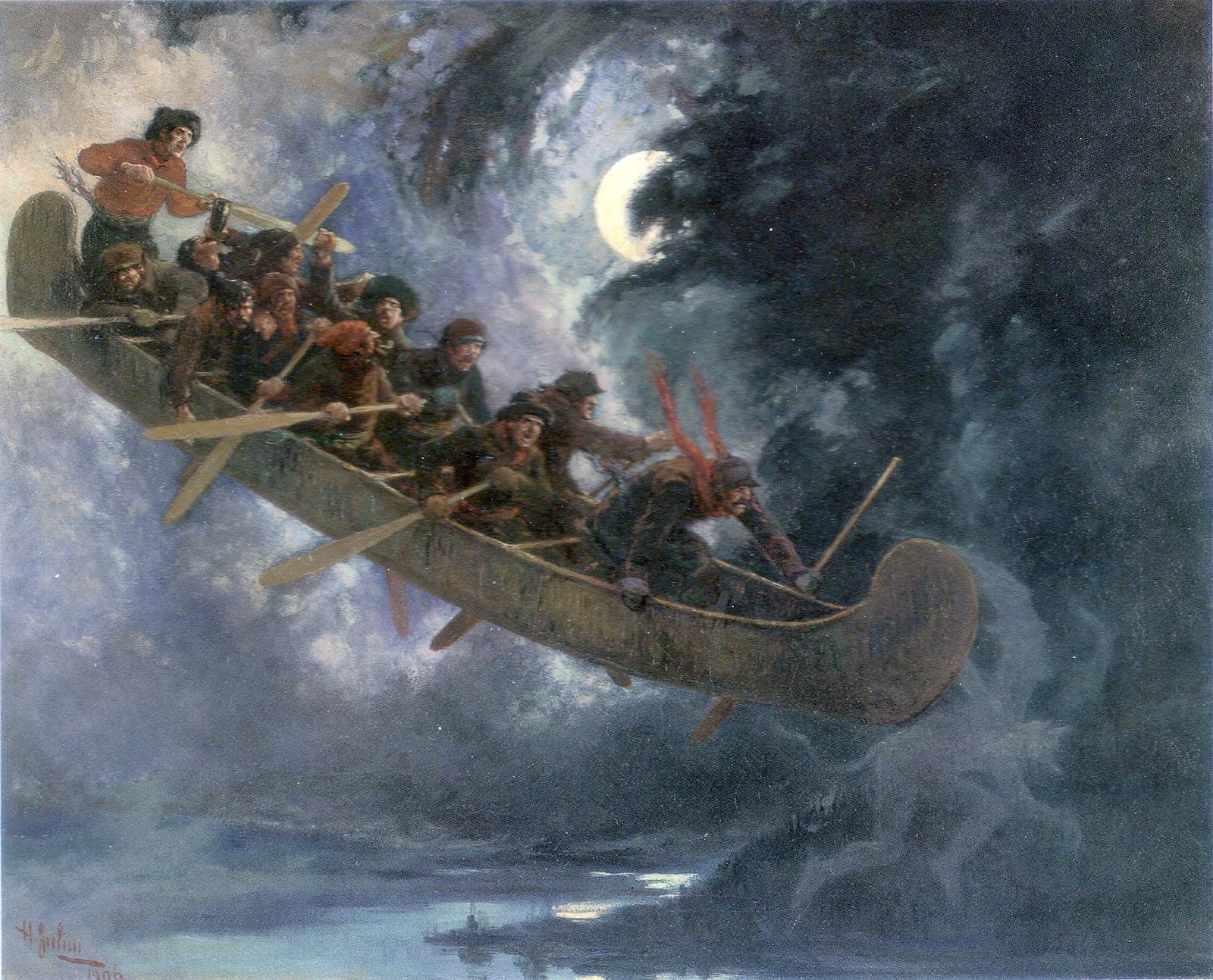
    a canoe that glides through the air


    Whatever this magic item is, it's fundamentally a tool with an ordinary purpose.  In the stories, it's used in some special way:

    • Some tools are just very, very good at what they do: a key that opens any lock, an arrow that always strikes its target, a cooking pot that makes all food delicious.
    • Some tools are used in the usual way, but with a different target than you'd expect, or operating in a different medium: a canoe that glides through the air, a ladder to climb to the night sky, a drum that can only be heard by the dead.
    • Some tools are used in a very unexpected way, or used like something with a vaguely similar form: a spoon that digs better than a shovel, a tentpole that shoots like a musket, a mitten that unfolds to be used as a tent.

    Supposed Function (d10)
    1-4Used for the usual purpose, but works unreasonably well.
    5-8Used in the usual way, but with an unexpected target or medium.
    9-10Used in an unexpected way, or as something with a vaguely similar form.

    an axe that chops down the largest of trees


    In the stories, it was always wielded by the same person.  The item belongs to them, at least in the popular imagination.

    Wielded By (d6)
    1-2a clever craftsman who made it (d4) 1: a while back, 2: far away, 3: for a wealthy patron, 4: for the gods
    3-4a rising figure out on the frontier (d4) 1: a warlord, 2: a prophet, 3: a bringer of justice, 4: a renegade
    5-6a culture hero who might have been real (d4) 1: a trickster, 2: a wise grandmotherly figure, 3: a kid who always finds a way out of trouble, 4: a thief/pirate

    a rope that can lasso the sun


    The stories tell what this object looks like.  If it's a knife, it's not just a regular knife; it glows in the moonlight or it has blood on it that won't wash off.

    Appearance (d8)
    1writing/picture/symbol carved into it
    2has blood on it that won't wash off
    3much larger than it has any right to be
    4wrapped/covered in crow feathers, salmon skin, buffalo hide
    5shiny, brightly colored, glows at night
    6got some kind of eyes, hands, or feet
    7makes a ringing or singing sound
    8in an ancient style, worn smooth

    a harpoon that catches the skin off a creature while it swims off to grow a new one


    Legends and powers aside, if you find this tool, you might not want it.  Rare and famous things bring all kinds of problems, but if you need some ideas for what trouble this brings, roll a die.

    Problem (d8)
    1stolen from someone very powerful
    2broken, fragile, bent, missing a piece
    3people expect its holder to fulfill the original role from folklore
    4troubled people need its help
    5believers say it is a sign of the prophecy
    6thieves/pirates on the lookout for it
    7said to work too well: axe that keeps cutting down trees, shoes that make you walk too far
    8said to stop working at inopportune moments


    Roll up your own magic tool of folklore:

    random magic tool
    tool
    function
    wielded by
    appearance
    problem

    Tuesday, September 4, 2018

    Some newfangled contraptions: the spindly Sun-Walker, Pellet Lanterns, and the Silver Sight

    I've been rolling up some strange newfangled contraptions, and I thought you might find some of them interesting.

    The Sun-Walker


    An enormous mechanical creation up high on spindly legs, the Sun-Walker is made mostly of brass.  Glass lenses concentrate sunlight onto fine metal spindles and vanes, causing them to bend and flex, moving the Walker inexorably forwards.  Its legs are articulated to lift high with each step, allowing the Walker to slowly traverse some of the most rugged terrain.

    The inventor has tried to market the device, but it has only been ridiculed in the local press.  It's hard to control, but the inventor is confident that it can be improved.

    Kinda like this, but with more sunlight and less smoke.  (ebalint96)


    Pellet Lanterns


    A safer, longer-lasting lantern has been invented.  A single pellet can keep it glowing for an hour, it doesn't warm up, and it won't ignite explosive gases down in the mines.

    The lantern is a small glass globe (inside a protective wire cage) with a geared mechanism attached to one end.  You stick in a pellet and turn the crank; the pellet is crushed to a fine powder that glows with a bright bluish light inside the glass.

    The lanterns themselves aren't that expensive, and you can buy a hundred pellets for just a shilling.  Or at least, you could.  Trouble is, there's a legal battle going on over who owns the imperial license to manufacture the pellets.

    Imagine a cross between a pepper grinder and one of these old lanterns.  (Garrett Wade)


    The Silver Sight


    The Sight is a colossal telescopic device, mounted on a track so it can swivel and aim in any direction.  A massive clockwork mechanism causes it to rotate as needed, powered by weights hanging from chains below the main platform.

    Inside the Sight are many colored glass lenses, complicated prisms, and silver reflectors.  It collects not light, but some other form of ray that can bend over the horizon.  Looking through the eyepiece, you can see the grey, indistinct forms of people hundreds of miles away.

    Not that you'll ever get to look through the Sight yourself.  Its existence is a closely-guarded state secret, an intelligence-gathering device belonging to the Viceroy, who uses it to extend imperial power (or rather, her own power) across the Northern Lands.

    A bit like this, but much bigger. (David Wenzel)

    Thursday, July 26, 2018

    Tech after the apocalypse

    This is a world of inventions and contraptions, a world where technology marches ever onwards. The apocalypse destroyed the old world, but so much of its knowledge survived. Here in the ruins, new things are invented all the time.

    There are two (somewhat contradictory) things to know about technology:
    • The finest things come from the Old Country before the fall.
    • The best things are being invented now.

    Old Finery


    The old elven empire was a land of millions of people in the early stages of an industrial revolution.  They had the finest silversmiths and gemcutters, the most precise instruments, and wealth—so much wealth, almost beyond imagining.

    (astronomical clock of Prague, Jay8085)


    When the people of the North first saw elven ships come sailing across the seas, they saw a great opportunity.  Wealth had come to them, in forms they never imagined, and they were determined to get some of it for themselves.

    (Spanish galleon)


    Today, after the end of the old world, elven finery from the lost homeland is highly treasured.  Old things are repaired and reworked many times over, so the ivory handle of that knife might have been part of a mantlepiece once, and the hands on that clock have been soldered back together a few times.

    Elven technology usually seems overcomplicated, with too many moving parts prone to failure.  And with the industrial base of the empire gone, every moving part has to be made by hand.  The toys of the old world will eventually break down for the last time.


    Modern Invention


    (David Bushnell's submarine Turtle)
    But let's forget about the past with its cramped cities and hidebound ways.  This is a new world, vast and full of opportunity.  People today are moving on, taking apart the fancy doodads of the olden days and making them into useful things, profitable inventions to hunt and fish and till the land.

    In Finnish mythology, the Sampo is a many-sided mill that makes all the things you need in life, crafted by the gods and fought over on earth.  Wondrous treasures like this are common in fantasy, given by (or stolen from) divine and legendary beings: Excalibur is given by the lady of the lake, Perseus got his winged sandals from Athena, Sigurd stole his ring from Fafnir's hoard.

    Taking after American stories, Signs in the Wilderness is a place where powerful things are created by mortals, not taken from the gods.  New contraptions and devices are being invented all the time and will surely change the world.  To put it another way...

    (Benjamin Franklin, by Benjamin West)

    In America, the Sampo is invented.

    Thursday, July 12, 2018

    Random book

    All manner of useful books can be found in the ruins or in private libraries.  Use the tables below to generate a random one:


    Topic

    Roll to see why this book is useful:

    Topic (d4)usefulnesstitle structure
    1technical manualhow to build/operate inventions (d8)
    1: alchemy (gunpowder, medicines, poisons),
    2: gunnery (pistols, muskets, rifles, cannons),
    3: steam engines (moving minecarts, paddlewheel boats, pumping air/water),
    4: shipbuilding (ships, boats, primitive wooden submarines),
    5: mechanical systems (gears, belts, pulleys, pistons),
    6: flight (kites, hot air / hydrogen balloons, parachutes),
    7: music (melodies, complex instruments),
    8: ciphers (encryption, codebreaking)
    (d6) 1: The Mechanical Codex,
    2: A Dictionary of the Art of Flight,
    3: Gunnery: or, a Treatise of the Art of Fire-Arms,
    4: The Construction and Principal Uses of Steam Engines,
    5: The Alchemical Triumph,
    6: A Dissertation on Shipbuilding
    2scientific workscience to help you find/use natural things (d6)
    1: geology (valuable minerals, caves),
    2: botany (plants, herbs, poisons),
    3: zoology (strange and dangerous creatures),
    4: astronomy (eclipses, comets),
    5: anthropology, in a broad sense (customs of other species),
    6: physiology (surgery, first aid, wounds)
    (d8) 1: Experiments and Observations on Geology,
    2: On the System or Theory of Astronomy,
    3: A Universal Dictionary of Zoology,
    4: A Treatise Concerning the Principles of Anthropology,
    5: The Doctrine of Lunar Eclipses,
    6: The New Science of Physiology,
    7: Elements of the Theory of Botany,
    8: Mysteries of Entomology
    3journallearn from experience about one or two of these (d6)
    1: a difficult river journey,
    2: navigating along a coastline / island chain,
    3: an overland wilderness route,
    4: a human/giantish group,
    5: barely surviving a dangerous wilderness,
    6: hunting strange creatures
    (d8) 1: A Short Narrative of the Voyage of the Dragonfly,
    2: An Account of the White River Expedition,
    3: A Voyage to the Black Sea,
    4: A Tour through the Whole of Seal-Eater Country,
    5: Voyages and Travels,
    6: Description of the Blue Mountains,
    7: Journey from Tara Nun to the High Gate,
    8: The Travels of Lt. Shima Avalath in the Eastern Isles
    4miscellaneous(d6) 1: official history,
    2: prophecies and predictions,
    3: journal of personal observations and secrets,
    4: accounting books showing bribes and money laundering,
    5: schedule of shipping/deliveries,
    6: information about famous people
    History of the Shining Spire,
    Meditations upon Things to Come,
    Analects of the City of Copper,
    The Judgement of the Empire,
    An Account of the Lives and Works of the Most Eminent Silversmiths,
    A General History of Notorious Pyrates,
    The True Speaker's Almanack,
    The Beginning and Progress of the Western War,
    The True History of the Conquest of the Summer Isles,
    (untitled)

    Details


    Roll up to three times for Details about the state of this book:

    Details (d6)
    1many woodcut illustrations
    2condition (d4)
    1: surprisingly pristine, with crisp pages,
    2: poorly printed from bad type, some letters and whole pages being hard to read,
    3: worn, with dog-eared pages,
    4: falling apart
    3missing pages/chapters
    4something tucked into the pages (d6)
    1: a hand-drawn map,
    2: a dry leaf/flower,
    3: an important folded-up page from another book (roll for Topic),
    4: a letter to the previous owner warning of danger,
    5: paper money or a note entitling the bearer to some reward,
    6: a sketch of an important person/scene/event
    5unusual size (d8)
    1-2: large, about a foot and a half across (46 cm),
    3: very large, about two feet across (61 cm),
    4: easily a thousand pages thick,
    5-6: a thin folio of only a dozen pages or so,
    7-8: small, about 4 inches across (10 cm)
    6handwritten notes in the margins (d6)
    1: corrections from a later scientist/explorer/etc.,
    2: secret details not included in the main text,
    3: hints of further, hidden information,
    4: warnings not to pursue some danger,
    5: unhinged philosophical ramblings,
    6: roll again, but the notes are encrypted

    Let's try rolling up a few:
    • A handwritten journal of personal observations and secrets, so worn that it's practically just a sheaf of loose papers in an old leather cover.  Notes are written in the margins (in different handwriting) rebutting and contradicting the main text.
    • The Construction and Principal Uses of Balloons, a dry text on small balloons and the sorts of meteorological experminents one can use them for.  Handwritten notes on some of the pages seem to be from the author, talking about their experiments with larger balloons that can carry people, but most of the notes refer to their logbook, elsewhere.  There's a strange note tucked in the pages, recognizing that the bearer has deposited twelve silver dollars with the Temple of the Tasselled Drum.

    random book
    topic
    details

    Wednesday, June 27, 2018

    On the System or Theory of Pharmacology

    An old textbook found in a ruined house, pointing to an old secret that has repercussions today.
    title page of "Pharmacopoeia Londinensis" from 1654

    ON THE SYSTEM
    or Theory of Pharmacology
    or, a Treatise
    concerning the Principles
    of the
    New Elements of Medicinal Preparations

    The book describes a wide number of medicines for all sorts of ailments.  Some make use of astrological theories, but most have a basis in some kind of medical knowledge.

    There are a number of handwritten notes in the margins, but enciphered in some way to protect their secrets.  Dangerous poisons?  Private memoirs?  Secret confessions?

    A folded-up page is tucked in the book, an old single broadsheet newspaper that's been folded and unfolded many times.  The main article is about someone famous at the time being poisoned.  It's not clear from the article whether the poison killed them or not.

    The book and the newspaper were published within a year of each other in the same city, a decade or so after the apocalypse.  There's a chance the author might still be alive today.

    After forty years or so, how could the secret in the margins still matter now?